
An internship cover letter is a one-page document that highlights your skills, education, and motivation to show employers why you are a strong candidate. It follows a clear structure with seven sections, including the heading, greeting, introduction, qualifications and experience, reasons for applying, call to action, and sign off.
Nevertheless, writing one can feel overwhelming at first, especially if you are unsure what to include. To help you, we’ve made this guide on how to write an internship cover letter, breaking the process down into simple steps so you can highlight your strengths easily and impress recruiters.
Key Takeaways
Your internship cover letter should follow a business letter format of around 250–400 words, use 1.15 line spacing, and be written in a professional font.
It should begin with a clear heading, a personalized greeting, and a focused introduction that states who you are and the role you are applying for.
The main body should highlight your qualifications, skills, and experiences, while clearly explaining your reasons for applying.
You should end the cover letter with a strong call to action, a closing statement reinforcing your fit, and a professional sign-off with your name.
Focus on using the right keywords, tailoring your letter to the company, highlighting education and extracurriculars, and showing what you gain professionally.
2 Outstanding Internship Cover Letter Examples
Before we show you how to write a cover letter for an internship, let’s examine two internship cover letter examples:
How to Choose the Right Format for an Internship Cover Letter
Formatting your cover letter properly will let hiring professionals find all the information about you they need—your skills, qualifications, strengths, etc.—effortlessly.
The primary purpose of an internship cover letter for both students and graduates is to tell a story about your ambitions and career goals, coupled with an internship resume.
Your cover letter should be intelligible, easy to read, and professional-looking. To achieve that, you should:
Go for a business letter format
Write everything you want in 250–400 words
Set margins at 1–1.5 inches on each side
Choose a professional-looking font (Times New Roman, Calibri, Cambria, Arial, etc.)
Set the font size at 10.5–12 points
Set the line spacing at 1.15
Don’t experiment with various patterns and colors. Though they look appealing, these design elements may make reading difficult, particularly when printed in black and white.
7 Main Sections of an Internship Cover Letter

To help you craft a splendid cover letter for an entry-level position or your first job, we’ll show you what elements the best internship cover letter should include.
#1. Heading
A cover letter header is the opening section that introduces both the applicant’s and the recipient’s contact information. As for the applicant, it typically includes:
Full name
Professional title
Phone number
Email address
Location
Date of the internship application
You may also include a link to your LinkedIn profile or personal portfolio if it adds relevant context to your application.
As for the recipient, it lists the hiring professional’s full name, job title, company name, and company location.
The goal of this section is to help employers quickly identify who the application is from and who it is addressed to. That said, here’s a good example of a cover letter heading:
Cover Letter Heading Example
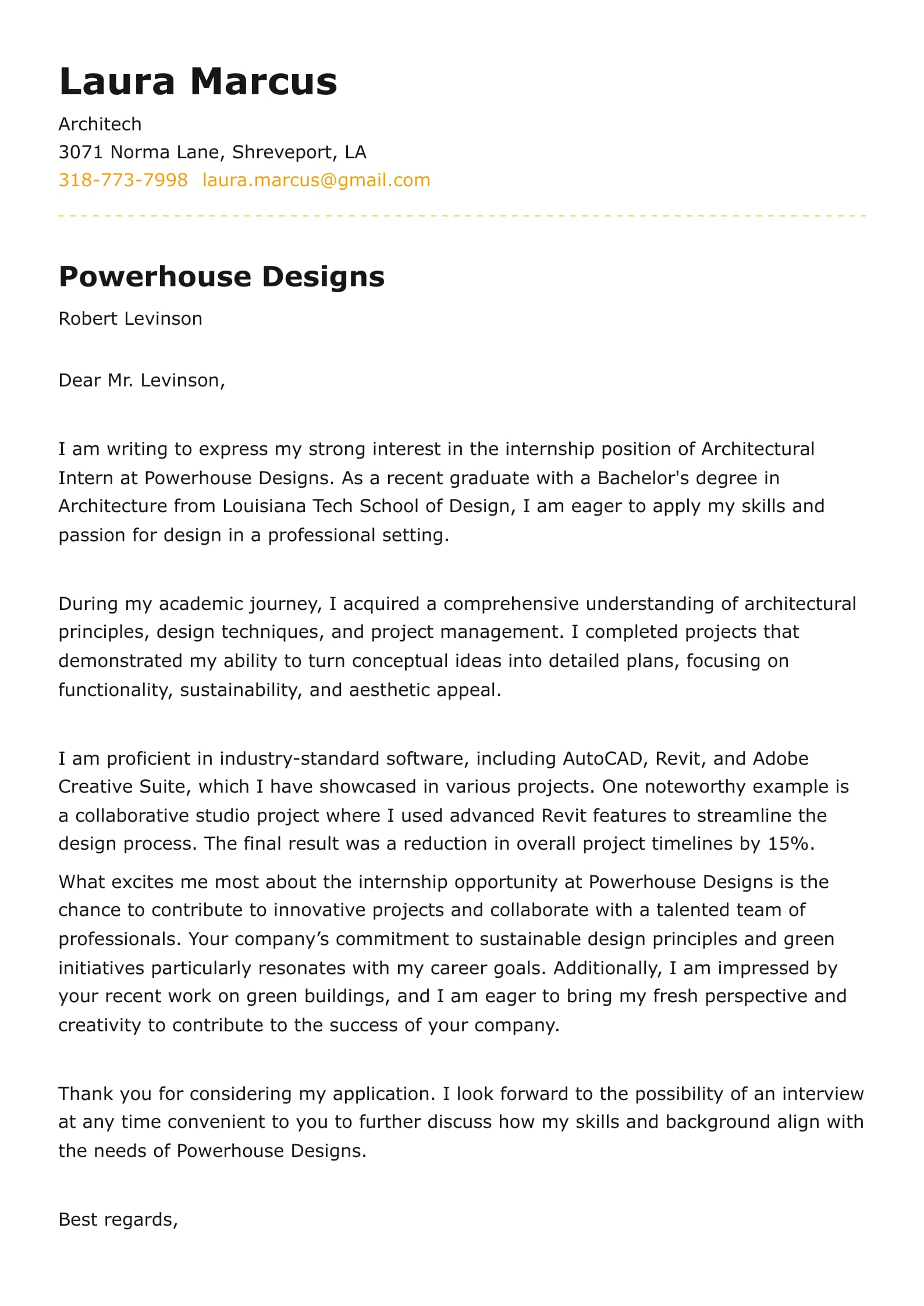
Laura Marcus
Architect
3071 Norma Lane
Shreveport, LA
laura.marcus@gmail.com
318-773-7998
Shreveport, December 12, 2023
Robert Levinson
Hiring Manager
Powerhouse Designs
4969 Tecumseh Road
Shreveport, LA
Double-check all the details and make sure that there are no typos. You don’t want to leave a bad impression on a hiring manager by misspelling their name, nor do you want your contact information to differ from that included in your resume.
#2. Greeting
You may have heard that you should address the hiring professional as Sir or Madam to keep your cover letter professional and formal. While you should indeed remain professional, this greeting is not the right choice. It is obsolete, generic, and may indicate that you’re too lazy.
Since a cover letter should be personalized, you need a more approachable greeting that includes the hiring manager’s name. Try to find it in the job posting or by researching the company personnel on its official website.
Here are a few good alternatives to the outdated ‘Dear Sir/Madam’:
Cover Letter Greeting Examples
Dear Robert,
Dear Mr. Levinson,
Dear Hiring Manager,
#3. Introduction
The opening paragraph of your cover letter gives you a chance to grab a recruiter’s attention right off the bat. Here, you should introduce yourself by highlighting your most recent achievements, key skills, and qualifications that are relevant to the position.
This is what an introductory paragraph should look like:
Cover Letter Introduction Example
I am writing to express my strong interest in the position of Architectural Intern at Powerhouse Designs. As a recent graduate with a Bachelor's degree in Architecture from Louisiana Tech School of Design, I am eager to apply my skills and passion for design in a professional setting.
#4. Qualifications & Experiences
The following two or three paragraphs are the most important in your cover letter. Here, you should mention the key qualifications and skills you’ve acquired. According to the National Association of Colleges and Employers (NACE), 70% of employers now use skills-based hiring, which means hiring decisions are increasingly based on what you can demonstrate. If you’ve participated in any projects where you applied skills relevant to the internship, do not hesitate to include them.
You should also mention your knowledge of software, platforms, social media, or any other tools that you’d be using in the internship position. Here’s how to go with this section:
Qualitifications Section Example
During my academic journey, I acquired a comprehensive understanding of architectural principles, design techniques, and project management. I completed projects that demonstrated my ability to turn conceptual ideas into detailed plans, focusing on functionality, sustainability, and aesthetic appeal.
I am proficient in industry-standard software, including AutoCAD, Revit, and Adobe Creative Suite, which I have showcased in various projects. One noteworthy example is a collaborative studio project where I used advanced Revit features to streamline the design process. The final result was a reduction in overall project timelines by 15%.
#5. Reasons for Applying
In this section, you should explain why you’re interested in the internship position. Focus on your opportunity to learn and acquire new skills, your career goals, and how the position can contribute to your career path.
Here’s how to phrase this section:
Cover Letter Reasons for Applying Section Example
What excites me most about the internship opportunity at Powerhouse Designs is the chance to contribute to innovative projects and collaborate with a talented team of professionals. Your company’s commitment to sustainable design principles and green initiatives particularly resonates with my career goals. Additionally, I am impressed by your recent work on green buildings, and I am eager to bring my fresh perspective and creativity in order to contribute to the success of your company.
#6. Call to Action
Use this section to inform a hiring manager that you’re ready to move on to the next stage of the hiring process. Mention politely that you’re available for an interview, and respectfully encourage them to schedule it.
Don’t skip this section; not adding a call to action may be a hint to a recruiter that you’re not willing to take the initiative, which may automatically flag you as a bad candidate.
Check out how to implement a subtle yet effective call to action in your internship cover letter:
Cover Letter CTA Example
Thank you for considering my application. I look forward to the possibility of an interview at any time convenient to you to further discuss how my skills and background align with the needs of Powerhouse Designs.
#7. Conclusion & Sign-Off
If you’re used to closing your emails with ‘Yours truly,’ don’t do so with your cover letter. Just like the ‘Dear Sir or Madam’ greeting, these expressions are overly formal and distant.
The following phrases are much better alternatives to your internship cover letter closing:
Yours sincerely
Yours faithfully
Best regards,
Kind regards,
Warm regards,
With best regards,
Respectfully,
Thanks in advance,
With gratitude,
Add your full name below the sign-off. You may even sign your cover letter if you’re sending it via mail; otherwise, typing your name will be enough.
Here’s an example of the closing section:
Cover Letter Conclusion & Sign-Off Example
Best regards,
Laura Marcus
How to Write a Cover Letter With No Experience

Writing a cover letter with no experience is all about proving that you can perform key parts of the role using your academic, personal, or project-based work. That said, let’s see how to do this step by step:
#1. Analyze the Job Description
Start by breaking down the job description since this allows you to tailor your cover letter, aligning your content directly with how recruiters evaluate candidates during initial screening. To this properly, follow these three simple steps:
Identify 3 to 5 skills or responsibilities that appear consistently in the posting
Focus on practical tasks such as writing, researching, or analyzing data
Reuse key terms naturally so your letter aligns with scanning patterns
#2. Structure Your Opening Paragraph Properly
The opening paragraph should include a clear statement of the position, a concise explanation of why the company is relevant to you, and how your strengths make you a suitable candidate.
For example:
Opening Paragraph Example
I am applying for the Junior Data Analyst role at Apex Insights after reviewing your recent case study on reducing customer churn through behavioral data, which stood out for its clear use of segmentation.
In my coursework, I analyzed survey datasets using Excel and basic SQL to identify patterns in user behavior, and I can contribute by organizing data and translating findings into structured insights that support decision-making.
#3. Demonstrate Your Skills and Qualifications in the Body Paragraph
The body paragraph should demonstrate your skills in action. Explain the context, the actions you took, and the outcomes you achieved to transform coursework, projects, or volunteer experience into evidence that supports your candidacy.
For instance:
Body Paragraph Example
In a recent data analysis project, I worked with a dataset of over 5,000 customer survey responses to identify patterns in user satisfaction. I cleaned and organized the data in Excel, then used basic SQL queries to segment responses by demographics and behavior.
Through this process, I identified a clear drop in satisfaction among repeat users and presented it in a structured report with visual summaries. My recommendations focused on improving retention strategies, and the project was recognized for its practical insights.
#4. Close With a Call to Action and Professional Sign Off
A short follow-up section should connect your skills and qualifications directly to the role by referencing actual responsibilities from the job description and explaining how your past work prepares you to handle similar tasks.
Reaffirm your fit based on demonstrated skills
Express interest in discussing the role further
Thank the reviewer
Here’s how that might look like in practice:
Closing Paragraph Example
Given the skills I’ve demonstrated through my customer survey project, I would welcome the opportunity to discuss how my background fits your team's needs. Thank you for your time, and I look forward to hearing from you.
Best regards,
John Smith
7 Effective Tips for Writing an Internship Cover Letter
To make cover letter writing less distressing, we present you with seven strategies for nailing your internship application:
Mention the right keywords. Upon receiving your letter, a hiring professional will scan it for the position-specific keywords to make sure you’re qualified for the internship. To find out what phrases to include, re-read the job posting and identify the most important keywords.
Customize your cover letter. One of the biggest cover letter mistakes to make is sending a one-size-fits-all or AI-generated document. Hiring professionals are not great fans of such letters and will discard them immediately. Instead, customize your cover letter by adding some information about the company.
Highlight your education and extracurriculars. Since you don’t have much working experience, your education and extracurricular activities are an ace up your sleeve. Underscore all the courses you have attended and completed that are relevant to the internship you’re applying for.
Explain why you’re a good fit. Adding your skills and competencies to your internship cover letter is not always sufficient; you also need to persuade a hiring manager why you’re the right candidate for the internship. Research what the company is looking for in interns and elaborate on what you can do to meet its needs.
Describe what you will gain. Besides elaborating on how you can contribute to the company’s growth, state how you can benefit from it and grow professionally. In doing so, you can demonstrate your willingness to learn, which is a highly valued trait for interns. Such self-awareness will help you leave an even greater impression on a hiring professional.
Proofread your cover letter. Never submit a cover letter without proofreading it for spelling or grammatical errors. Typos will show a recruiter that you don’t pay great attention to details.
Use cover letter examples and templates strategically. Professional cover letter examples can help you understand how strong applications are structured and how candidates present skills in context. Use them as references, but create your own original content based on your skills, projects, and motivation.
Build an Internship-Ready Cover Letter With Resume.co
With our cover letter builder, you can turn your skills, projects, and coursework into clear, results-focused content that employers can quickly understand. Also, to keep everything consistent across applications and optimized for ATS, use our AI-powered resume builder.
Present yourself as a job-ready candidate from the start with our comprehensive tool set.
Turn Your Skills Into Offers
Build a cover letterFinal Thoughts
In the end, a strong internship cover letter comes down to structure, clarity, and relevance. When you use the 7-section format, you give your application a logical flow that makes it easy for hiring managers to follow and understand your value. That’s why it’s wise to use a cover letter template as guidance.
Internship experience is a strong foundation for a future career. Research shows that applicants with internship experience are 12.6% more likely to be invited to a job interview. As long as you stay focused, tailor each letter to the role, and keep the writing clean and error-free, your cover letter will be a strong tool for getting you noticed and landing interviews.
Internship Cover Letter FAQs
#1. How long should an internship cover letter be?
An internship cover letter should be about half a page to one full page, typically 250 to 400 words. It should include a short introduction, one focused body paragraph with examples, and a clear closing, without repeating your resume.
#2. What are some common mistakes when writing an internship cover letter?
Common mistakes include being too generic, repeating your resume, focusing on what you want instead of what you offer, and failing to include specific examples. Many applicants also overuse buzzwords without showing real proof of skills or effort.
#3. What makes a strong internship cover letter?
A strong internship cover letter clearly connects your skills to the role using specific examples from coursework, projects, or volunteer experience. It shows you understand the company and explains how you can contribute, even without formal job titles.